How to build a backyard batting cage
A backyard batting cage is a long net tunnel, usually 55 or 70 feet long, about 14 feet wide and 12 feet high, hung from poles or from cables strung between poles. You need a flat strip of yard about 10 feet longer and 8 feet wider than the cage, a net with the right twine for your hitter's age, and a frame that holds the net loosely. Plan on a weekend of work for a kit and a few hundred to several thousand dollars, depending mostly on length.
The numbers below come from net manufacturers and suppliers, listed at the end. We haven't built and tested these cages ourselves.
1. Measure your space first
Length decides almost everything else, so start there. The pitching distance for your hitter tells you how long the cage has to be, plus room behind the plate and behind the pitcher or machine.
| Who's hitting | Pitching distance | Cage length |
|---|---|---|
| Tee work and soft toss only | none | 20 to 35 ft |
| Little League (younger divisions 38 ft) | 46 ft | 55 ft |
| Middle school, travel ball | 54 ft | 55 ft minimum, 70 ft better |
| Fastpitch softball (high school, college) | 43 ft | 55 ft |
| High school, college, adults | 60 ft 6 in | 70 ft |
Width is 12 feet for younger players and 14 feet once hitters swing hard from both sides of the plate. Height is 12 feet in most kits; 10 feet works for kids, and some suppliers say 8 feet is acceptable when nothing else fits.
Then add clearance around the net. CoverSports recommends 3 to 5 feet between the net and a fence or wall, at least 3 feet behind the batter and 5 to 10 feet behind the pitcher. For a 55-foot cage that means a strip of roughly 65 by 22 feet. A quick rule if space is tight: take your longest open stretch of yard and subtract 10 to 15 feet. That's your maximum cage length.
Before you mark anything, look up. Power lines, phone cables and overhanging branches are the most common reason a planned spot doesn't work.
2. Choose the net
Batting cage netting is sold by twine size. A higher number means thicker twine, a heavier net and a longer life. For a backyard, three sizes cover nearly everyone:
| Twine | Good for | Expected life (maker's estimate) |
|---|---|---|
| #21 / #24 HDPE | Kids, tee work, coach pitch, light use | 4 to 6 years with moderate use |
| #36 HDPE | Middle school to high school, machine pitching | longer, light commercial grade |
| #42 HDPE or nylon | High school and up, daily use, fast machines | the standard for schools and parks |
Anything under #18 isn't made for batting cages. Bird and garden netting looks similar online but won't stop a line drive.
Polyethylene or nylon?
Most outdoor backyard nets are polyethylene (HDPE). It doesn't absorb water, so it doesn't rot or shrink after a wet season, and it's cheaper. Nylon has a higher break strength out of the box, but it soaks up water and, according to Batting Cages Inc., loses 15 to 20 percent of its strength each year depending on conditions. By year three a polyethylene net of the same size can be just as strong. Nylon makes more sense indoors, in a barn or garage. Outdoors, look for a net that says UV-treated or UV-stabilized, especially in hot, sunny states.
3. Pick a frame
The frame only has to hold the net up and keep it from sagging onto the hitter. There are three common setups:
- Freestanding kit with poles: steel or fiberglass uprights with cross poles over the top, sold as a set with the net. The easiest option and the one you can take down or move. Smaller kits stand on stakes or sandbags.
- Cable and pole: one strong post at each end (and sometimes in the middle) with steel cables stretched between them. The net hangs from the cables on rings or clips. This is how most permanent backyard and commercial cages are built and it leaves no poles inside the tunnel.
- DIY frame: metal conduit, steel pipe, wood posts or PVC. PVC is cheap but bends and cracks in the sun, so it suits short cages for kids more than a 70-foot cage.
For permanent posts, Anytime Baseball Supply suggests 3 to 4 inch posts, about 14 feet long for a 12-foot cage, so 2 feet can go into the ground set in concrete. Corner posts take the most load when cables are tensioned, so they need the deepest footings.
A kit with frame and net
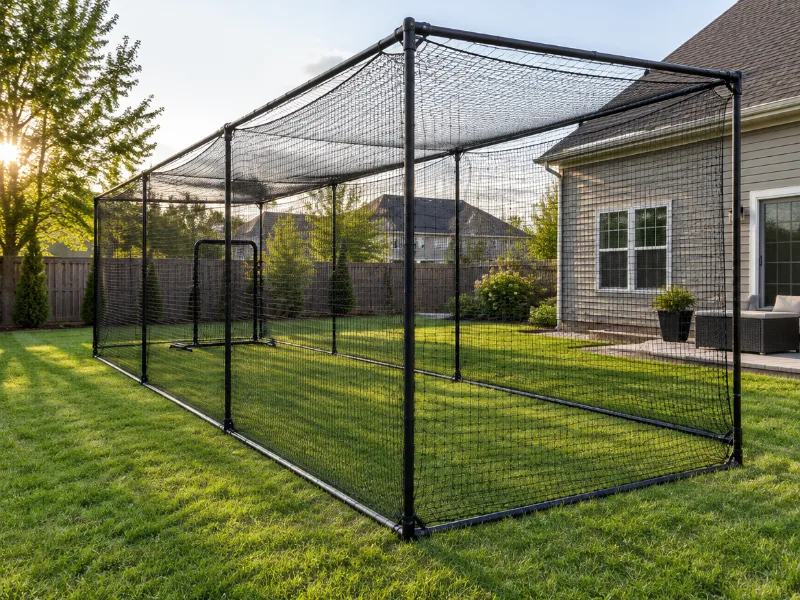
We haven't tested these ourselves; we chose them by size and specs. As an Amazon Associate we earn from qualifying purchases, at no extra cost to you. Check the current price on Amazon.
4. Prepare the ground
Clear rocks, roots and debris, fill low spots and check the strip with a level. A bad hop off a bump is how hitters get hurt in short cages. Grass is fine to start, but the area around home plate and the pitching spot wears down fast. A batting mat or a strip of turf there saves the lawn; for a full artificial turf floor, batting cage turf is sold in rolls about 15 feet wide that you cut to length.
If the yard runs east to west, put home plate on the east end. In the afternoon the sun is then behind the hitter instead of in their eyes.
5. Build it step by step
- Mark the footprint. Stake the four corners, run string between them and measure the diagonals. If both diagonals match, the layout is square.
- Call 811 before you dig. The free service marks buried gas, water and power lines in your yard, usually within a few days.
- Set the posts. Dig the post holes, set the posts plumb in concrete and let it cure fully before you put any load on them. Check the bag for cure time.
- Assemble the frame. For a pole kit, connect uprights and cross poles. For a cable system, attach the cables to the end posts and tension them with turnbuckles until they no longer sag in the middle.
- Hang the net. Clip or ring the net to the frame from one end to the other. Leave it loose: about 1 to 2 feet of extra net should rest on the ground around the edge. A tight net makes balls bounce back at the hitter.
- Close the ends. Use a door flap or overlapping net at one end so you can get in and out, and pin the bottom edge down so balls don't roll under.
- Add the gear. Home plate, a hitting mat and, for live or machine pitching, an L-screen to protect whoever feeds the balls. Electric pitching machines need an outdoor outlet or a heavy-duty extension cord.
Gear for inside the cage
-
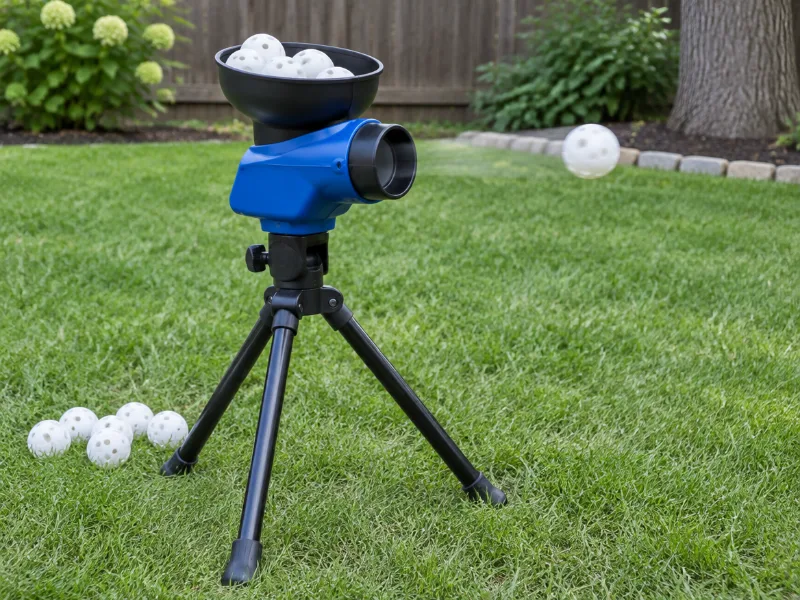 Illustration Bestseller Franklin Sports MLB electronic youth pitching machine Pitches plastic balls automatically, so a young hitter can practice alone. A gentle start before real-ball machines. View on Amazon
-
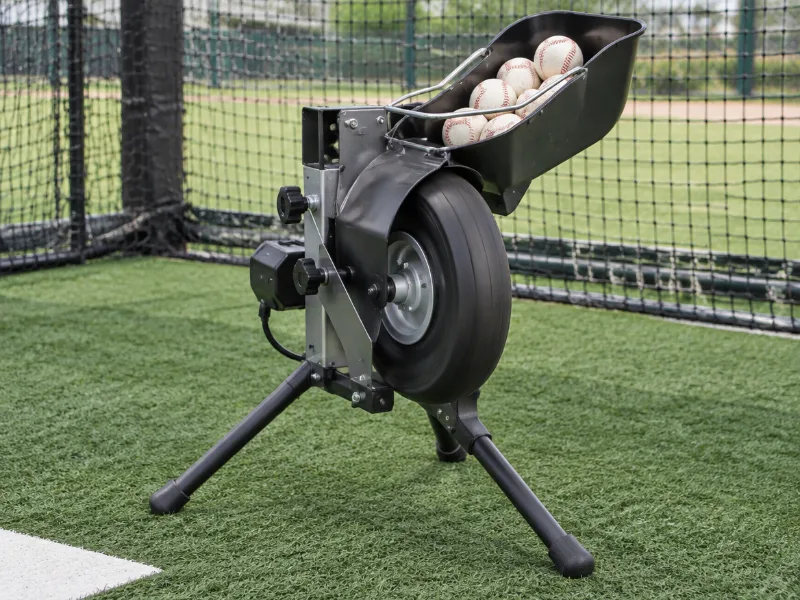 Illustration Heater Sports Base Hit pitching machine (real baseballs, up to 45 mph) Throws real baseballs at adjustable speed for older kids and teens. Needs an outdoor outlet or a heavy extension cord. View on Amazon
-
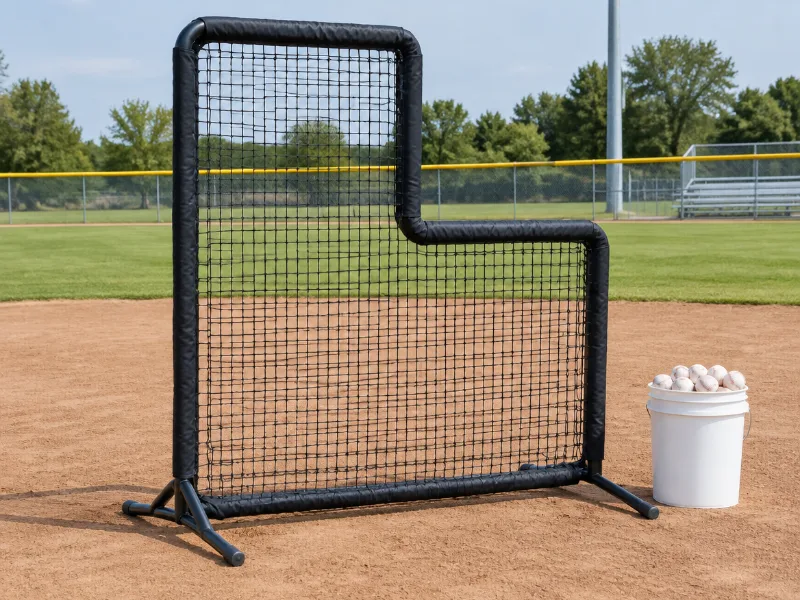 Illustration Safety Fortress regulation L-screen, 7 x 7 ft Protects whoever feeds the balls or pitches live. Put it about 40 feet from home plate. View on Amazon
-
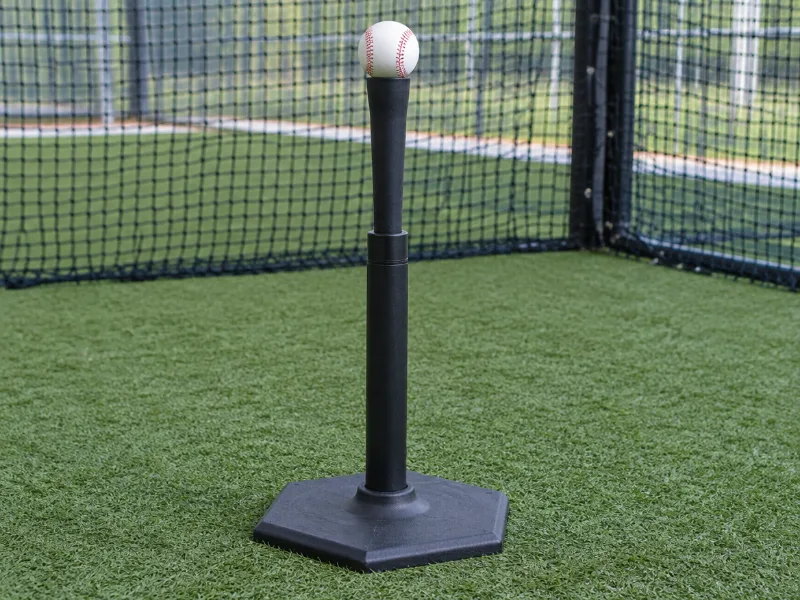 Illustration Franklin Sports MLB heavy-duty batting tee Tee work is the basic drill in any cage, and a heavy base keeps it standing after a hard swing. View on Amazon
-
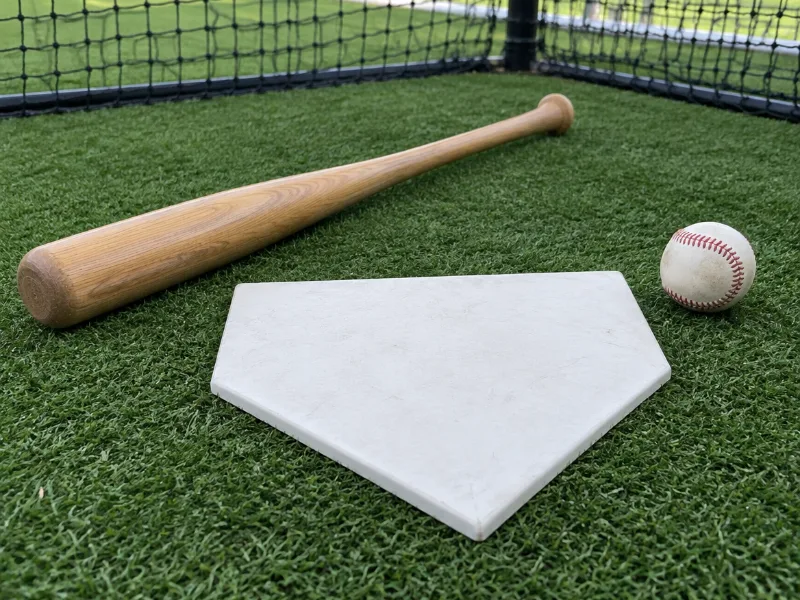 Illustration Franklin Sports rubber home plate, 17 x 17 inch Official size, so the strike zone feels right. Rubber lies flat on grass or a mat. View on Amazon
We haven't tested these ourselves; we chose them by size and specs. As an Amazon Associate we earn from qualifying purchases, at no extra cost to you. Check the current price on Amazon.
6. What it costs
Prices vary a lot by length and net weight. These ranges are from net maker PowerNet (Training Nets) and match what most kit sellers list:
| What | Typical range |
|---|---|
| Net only | $50 to $800 |
| Small cage, about 20 × 10 × 10 ft | $300 to $1,000 |
| Medium cage, about 40 × 12 × 10 ft | $1,000 to $3,500 |
| Full-size cage, 70 × 14 × 12 ft | $4,000 to $10,000 |
Building it yourself saves the installation fee, which pros charge separately. Budget extra for concrete, turf and a pitching machine. For comparison, renting a cage by the hour costs a median of $50 at the 22 facilities in our directory that post an hourly rate. If you'd hit once a week, a mid-range home cage pays for itself in a couple of seasons. Our batting cage price guide has the rental numbers.
7. Before you build
- Rules: check your HOA and your town. Posts set in concrete and taller than a fence can need approval.
- Neighbors: a net stops balls, but a cage right next to a window or a pool is still a bad spot. Pick the side of the yard with nothing breakable behind it.
- Noise: aluminum bats and pitching machines are loud. Early morning sessions don't make friends.
8. Keep it in shape
Walk the net every few weeks and look for frayed spots, especially behind the plate where most balls hit. Small holes are easy to tie shut; big ones grow fast. Check metal frames for rust and PVC for cracks. In snowy areas many owners lower or roll up the net for winter so snow and ice don't weigh down the frame.
No room in the yard?
Our directory lists batting cages across the US, including 813 indoor training facilities that rent cages by the hour. Search the map by city or ZIP code or start with indoor batting cages.
Sources
- CoverSports: Batting cage dimensions and setup guide (sizes, pitching distances, clearances, turf)
- Batting Cages Inc.: FAQ and twine size guide (net materials, twine sizes, net life)
- Anytime Baseball Supply: How to build a backyard DIY batting cage (posts, ground prep, tools)
- Training Nets (PowerNet): How much does a batting cage cost? (price ranges)